
Next Leap to Harness Engineering: JiuwenClaw Pioneers ‘Coordination Engineering’


How to make multiple agents work together like an elite team — autonomously dividing tasks, communicating efficiently, and collaborating seamlessly?
The openJiuwen community released the latest version of JiuwenClaw, which adds support for AgentTeam — a multi-agent collaborative capability. It proposes that the next leap beyond Harness Engineering is Coordination Engineering.
In in-depth tests, this team collaboration mechanism has demonstrated remarkable stability —team members have clear roles, collaborate autonomously with seamless coordination, and the entire workflow requires no human intervention.
How hardcore is it, really?
It can autonomously assemble a “well-trained” team of agents — and with that team, it can produce a solid, logically rigorous 200‑page technical PPT in under 20 minutes.
Project links: https://github.com/openJiuwen-ai/jiuwenclaw
Testing JiuwenClaw “Coordination Engineering” in Action
Want deep insights without lifting a finger? A 200‑page, content‑rich PPT in under 20 minutes.
In our trial, we asked it to conduct an in‑depth investigation of OpenClaw technology and break it down across 10 core aspects. For each aspect, it assigned a dedicated agent to take charge. Each agent was responsible for generating 20 PPT slides, all under a unified theme. Finally, the 10 sets of slides were merged into a complete, 200‑page technical presentation.
The entire process took less than 20 minutes. The resulting PPT was detailed, logically structured, and impressively efficient.
Technical Breakdown: Three Core Capabilities of JiuwenClaw AgentTeam
The core design philosophy of AgentTeam is straightforward: simulate how real-world teams collaborate.
- A Leader Agent is responsible for requirement analysis, team building, and task planning.
- Multiple Teammate Agents claim tasks, execute independently, report results, and collaborate through a shared workspace.
- During execution, key milestones require Leader approval, and fault recovery is automatic.
1. Hierarchical Autonomous Collaboration: Leader Orchestrates Intelligently, Teammates Execute Autonomously
JiuwenClaw AgentTeam delegates this responsibility to the Leader Agent itself.
What the Leader does:
- Dynamically builds the team: Assigns roles and members dynamically based on the goal. If more hands are needed mid-execution, it can add or remove members on the fly.
- Plans tasks: Breaks down the goal into concrete tasks, establishing dependencies (e.g., “analysis can only start after data collection is complete”).
- Assigns and monitors: After creating tasks, it tracks progress in real time—who claimed what, who completed what, who ran into issues—and adjusts accordingly.
What Teammates do:
- Claim tasks proactively: Browse the task board and claim tasks that match their capabilities.
- Execute independently: Complete their work within their own workspace.
- Report results: Update the status and notify the Leader and other dependents.
Team members drive the core workflow through task collaboration—claiming, executing, completing, unblocking downstream tasks—discussing plans, negotiating priorities, flagging issues, requesting support.
Both channels run in parallel, with task dependencies managed automatically—not simply mechanical distribution and aggregation.
2. Team Workspace: A Shared Team File Space
JiuwenClaw AgentTeam solves this with Team Workspace—a team‑level shared file space that all members can transparently access. Each Teammate’s working directory automatically mounts a shared path pointing to the same team workspace.
3. Full Lifecycle Management: From Plan Approval to Automatic Fault Recovery
3.1 Leader Approval
AgentTeam provides a two‑layer approval mechanism:
- Plan mode: For important tasks, a Teammate first submits an execution plan for Leader approval.
- Tool approval: When a Teammate needs to perform a sensitive operation (e.g., deleting files, calling external APIs, modifying shared configurations), Leader approval is required.
3.2 Event‑Driven Mechanism
AgentTeam mitigates this with an event‑driven mechanism, using both external and internal events:
- External events: Task state changes, member lifecycle changes, inter‑member messages—any meaningful change triggers an event.
- Internal events: Framework‑generated self‑check events (mailbox polling, task board polling) act as a safety net.
After an event is triggered, the relevant agents are automatically awakened (e.g., idle Teammates claim tasks, the Leader reassigns timed-out tasks)
3.3 Persistent Teams
With Persistent mode enabled, teams can be preserved across sessions: The next time you need the team, you can restore it with one click—create a new session space, restart the team members, and you’re ready to go, without rebuilding the team from scratch.
3.4 TeamMonitor
TeamMonitor providing observability in two dimensions:
- Query API: Check team information, member states, task progress, and other statuses at any time.
- Event stream: Subscribe to team events in real time. Task completions, member state changes, messages sent/received… all events can be consumed one by one via an asynchronous iterator. You can build dashboards, logging systems, or trigger external workflows from these events. Every step of the team’s operation is traceable and auditable.
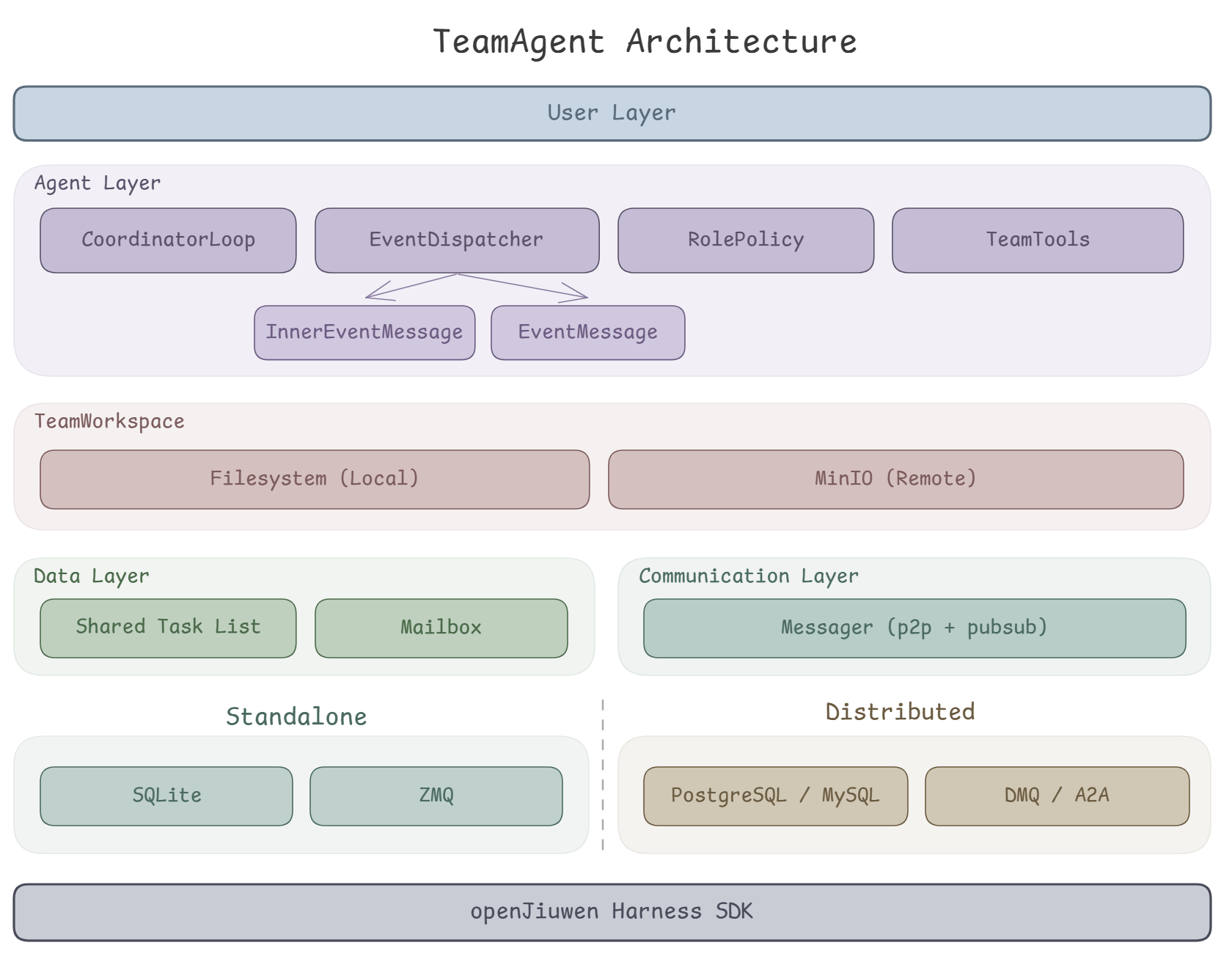
Core Underpinning: openJiuwen AgentTeam Architecture
The core technical principles of AgentTeam can be summarized in three points:
- Consistent collaboration via a shared task list: All members share the same dynamic task list. Each agent independently claims and executes tasks based on the team goal, task definitions, and its own capabilities—ensuring natural information consistency.
- Dual‑drive model of messages and tasks: Members drive the core workflow through task transitions, while also continuously discussing and negotiating via a message channel outside the task system—covering everything from structured execution to unstructured communication.
- Role and tool engineering: RolePolicy defines the behavioral norms and decision boundaries of the Leader and Teammates within the team. TeamTools endows team members with specific coordination capabilities. The role determines “what should be done,” and the tools determine “what can be done.”
About JiuwenClaw
JiuwenClaw is a “Claw” Agent developed on top of the openJiuwen open‑source community. It natively supports multi‑agent collaboration and agent self‑evolution. The core design philosophy is simple: Understand what you want, and evolve autonomously.
Beyond AgentTeam, JiuwenClaw is also very easy to install and deploy – a single command gets you up and running. For a quick start, refer to: https://github.com/openJiuwen-ai/jiuwenclaw/blob/develop/docs/en/Quickstart.md
In addition, JiuwenClaw offers several advantages in autonomous task planning, self‑evolution, context compression and offloading, browser manipulation, and overall “lobster‑like” handling:
- Autonomous task management: always ready when you are : JiuwenClaw features a task planning mode, which is essentially a to‑do list for the AI. Users can dynamically interrupt, append, or modify tasks at any time.
- Self‑evolving Skills: Proactively records these execution errors and feedback, analyzes the root cause, and generates targeted improvement suggestions. An evolution approval window then pops up for the user – every update is your call.
- Context compression & offloading : Effectively reduces costs by managing context length.
- Layered Memory: Achieves long-term storage and intelligent retrieval of scenarios and operation traces.
- Browser manipulation: Automatically accesses profile information like cookies and local cache, seamlessly taking over the browser environment.
About OfficeClaw
The enterprise-grade version, OfficeClaw, built on the Harness engineering foundation, seamlessly integrates task planning, multi-agent collaboration, tool invocation, and security governance on Huawei Cloud AgentArts, improving the success rate of complex office tasks.
Join the Community & Explore openJiuwen
openJiuwen Download Links
JiuwenClaw Download Links
- JiuwenClaw on GitHub: https://github.com/openJiuwen-ai/jiuwenclaw
- JiuwenClaw on AtomGit: https://gitcode.com/openJiuwen/jiuwenclaw
- AgentArts on Huawei Cloud:https://www.huaweicloud.com/product/agentarts
- OfficeClaw on Huawei Cloud:https://www.huaweicloud.com/product/agentarts/officeclaw.html
Note: Thanks to the OpenJiuwen team for the resources, images, video, and other details.

Michal Sutter is a data science professional with a Master of Science in Data Science from the University of Padova. With a solid foundation in statistical analysis, machine learning, and data engineering, Michal excels at transforming complex datasets into actionable insights.



